Tableaux Mortes:
Curtain Fall/The Emancipation of the
Self/Dark Continent/State of Bewilderness/Starry
Night, 2007- 8
The title is a pun
on the term ”Tableaux Vivants”
(“living pictures”) describing a completely stationary live theatrical scene.
The Tableaux Mortes, on the other hand, are not alive
but dead. The series is made up of large scale oils depicting theatrical scenes
and symbolic representations, raising issues of loss, irrevocability,
meaninglessness and death. Being the artistic medium most frequently confronted
with being hopelessly bygone and already departed, painting is the obvious
choice for rendering decay and destruction. At the same time as the large
format paintings are brought back from the doghouse of the 80’ies, the long
common stories are being dusted.
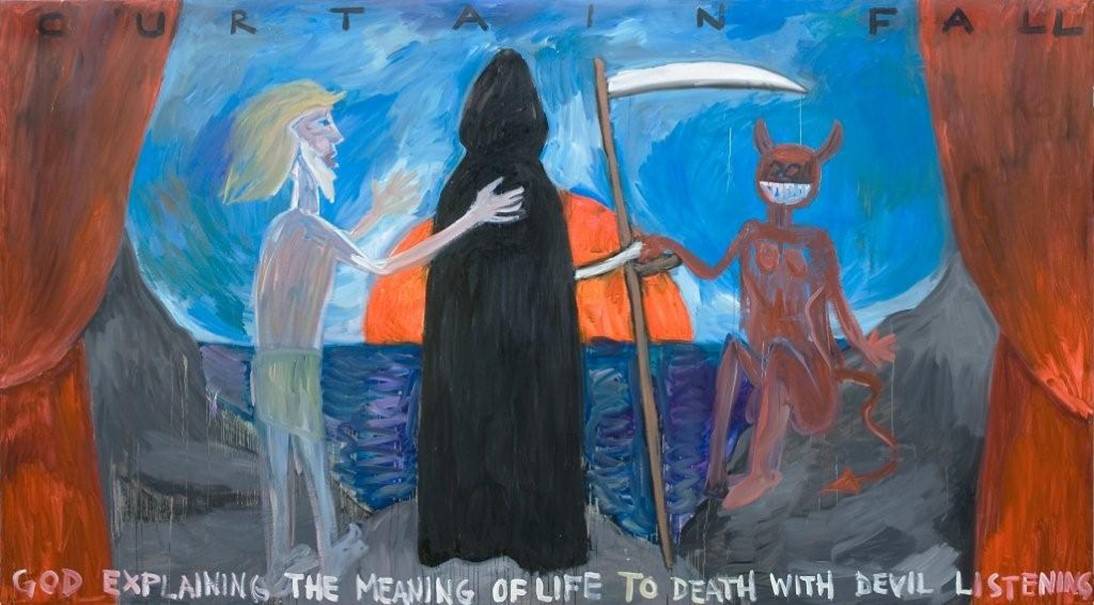
In Curtain Fall
(oil on canvas, 203 x 368 cm)
we are witnessing a scene in the last part of the last act, marked by a curtain
as frame. The sun is setting into the sea for the last time and God, in the
shape of man, is trying to explain the meaning of life to a melancholic Death,
with the devil as an indifferent but grinning bystander. Is meaning lost in the
big picture? Can any idea of purpose survive the fact that everything comes to
an end?
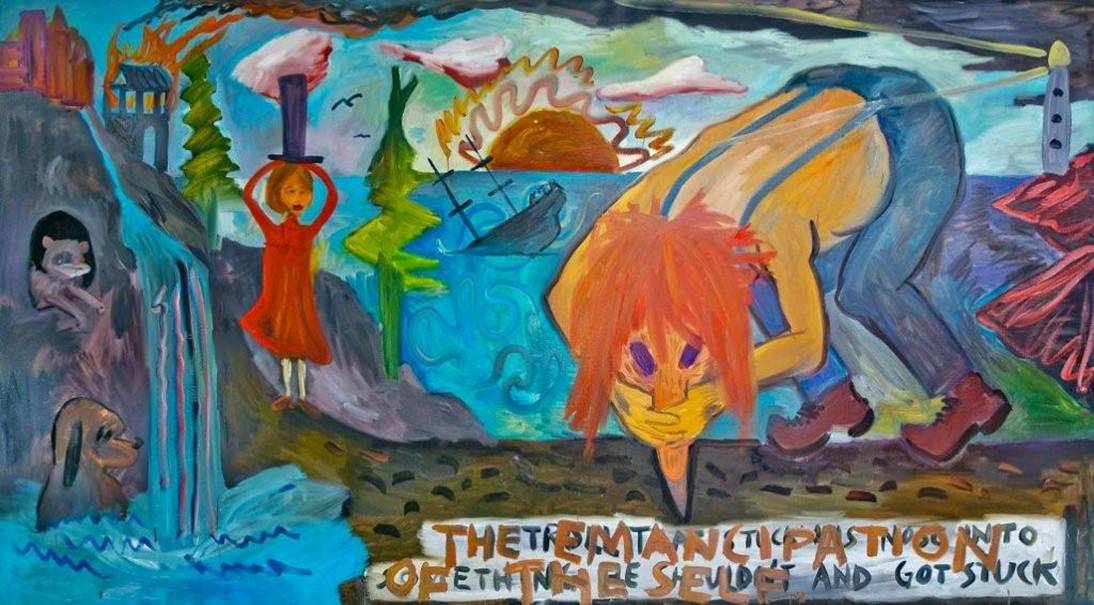
In The Emancipation
of the Self (oil on canvas, 203 x 362 cm) we see a troll with his nose stuck in a
hole in the ground, a red dressed girl with a high hat, a sinking ship, a
burning house, sunset and a lighthouse amongst other more or less obvious
symbols. Popular psychology has by its construction of symbolic connections
taken over much of the functions once held by mythology, popular belief and
fairytales. The idea being that the translation of symbolic correlations will
reveal depths of hidden meaning. This is similar to the traditional reading of
painting as a connection of symbolic references.
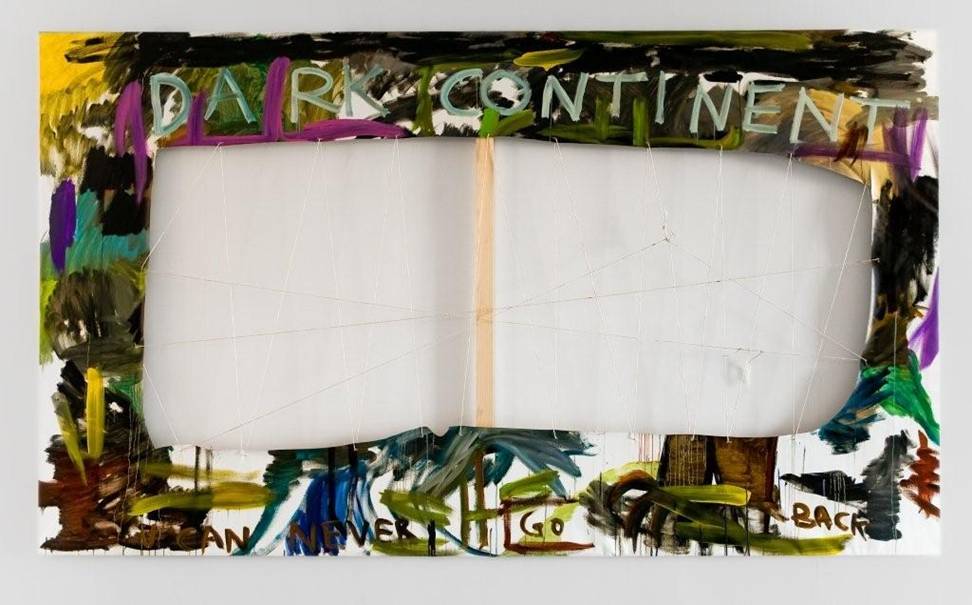
In Dark Continent (oil on canvas / mixed media, 205 x 355 cm) a large piece of the
canvas has been cut out and the wide open hole attempted sewn together by hemp
rope. The hopeless attempt at reconstruction is followed by the sentence: “you
can never go back”, a self-evident but brutal principle of life.
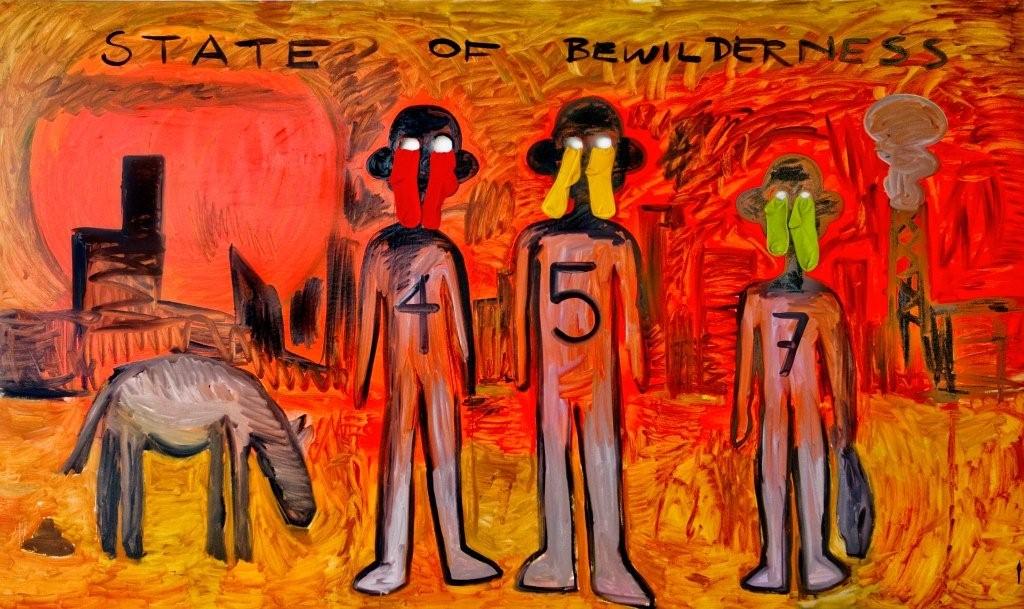
In State of Bewilderness
(oil on canvas / mixed media, 200 x 335 cm) we meet three dark figures in a barren
industrialised landscape, staring out of the picture in our direction. The eyes
are cut out holes from where socks softly hang. The title is in part a
construction from the two words ‘wilderness’ and ‘bewilderment’ and in part a
play on the double sense of the word ‘state’ as both a nation and a condition.
Is our murky inner quest for purpose mirrored in the governments diffuse
ambitions?
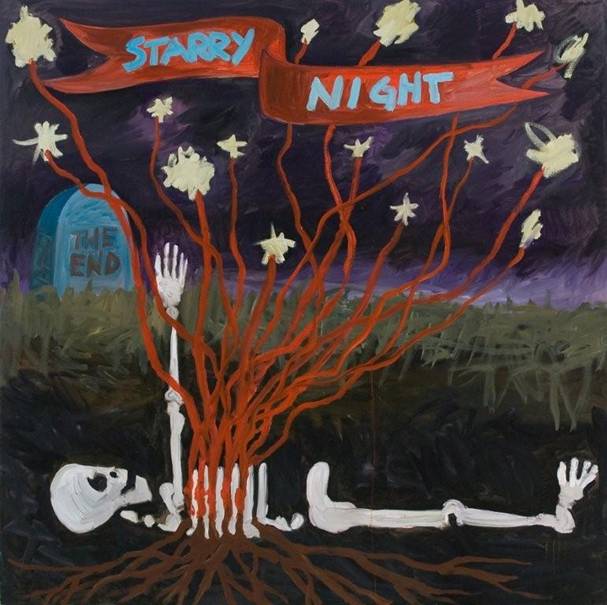
Starry Night (oil
on canvas, 195 x 195 cm)
has retrieved its title from renowned paintings of Van Gogh and Munch. Death is
here represented as the buried remains of an individual life. Not only does the
departed stretch his hand up towards the stars, his guts seem to be replaced by
vegetation tying the soil with the heavens. Even if consciousness is lost the
skeleton, in all its cold bleakness, might find a resonance in the large silent
starry night.
archive